The Jersey Rules
My rules for collecting jerseys - because limits have to be set

I had a trip planned for today and was actually quite excited about it - as indicated by the line I originally used to end my last post:
During the game, I found out about another team that plays in the building - in a sport I've been pretty interested in for a while.
However...there's a big snowstorm today.
Since I can't exactly head out in the middle of a snowstorm (PLUS the game I was going to go to got postponed), I figured I’d try my hand at some “side content”. I've been thinking about adding more posts like these to this blog for a bit, and while I'm still trying to figure out what types of things to write/post, it's a good way for me to keep updating this blog. Of course, this "side content" is also good for "rainy days" like today - though it's more of a "snowy day".
Today's topic: Jerseys.
I’ve mentioned it a few times here, but I’ve been collecting sports jerseys for a while now (to the point where I have a spreadsheet to keep track of what I have). However, because there are SO DAMN MANY of them and I REALLY need to do this in moderation (for various reasons), I’ve established a set of rules that I use to determine whether or not I go for a jersey.
RULE 1: It must be (decently) real
The thing with jerseys is that for various reasons, fake versions of jerseys have always existed. Nowadays, however, with how expensive jerseys have gotten (plus the fact that the quality tends to be...not so great), a lot of fans are turning to buying fake jerseys. Personally...I’m not a fan of it.
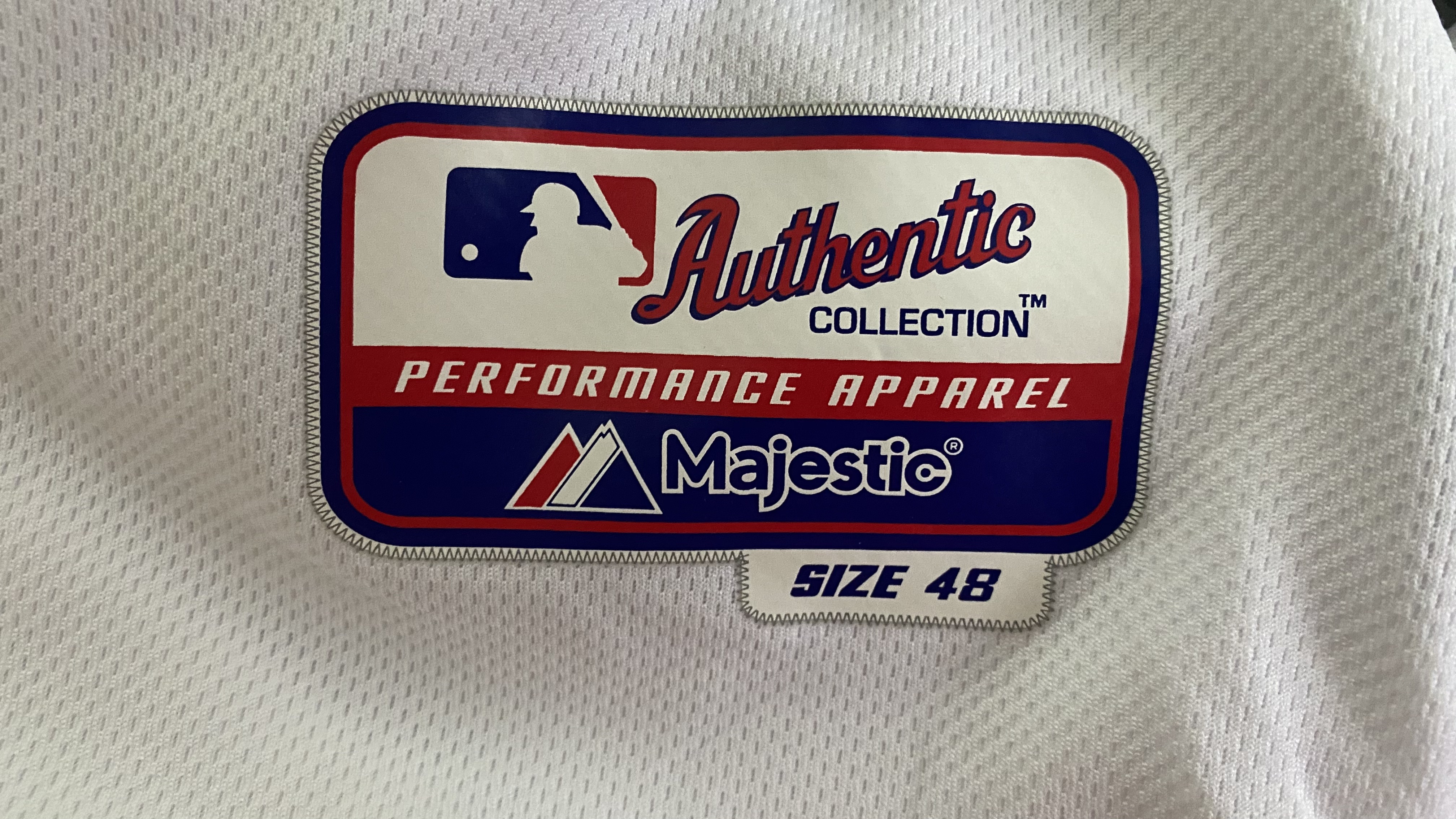
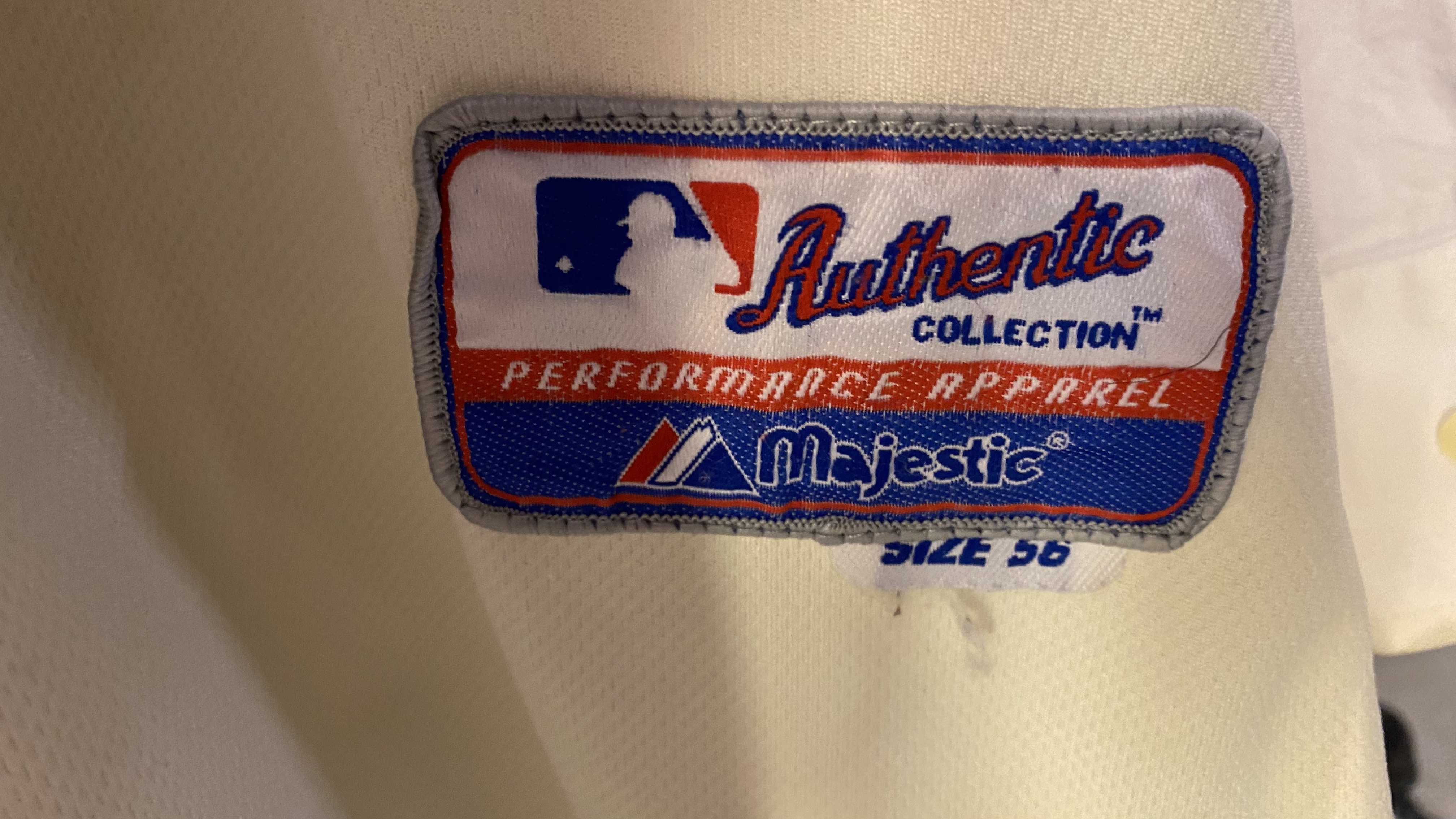
I won’t get into the legal ramifications of fake jerseys, but the reality is that a lot of fakes (especially back in the day) were, quite frankly, not all that great. They often featured features of lower quality, such as poorly executed front scripts/logos, lack of inner tags, and various other oddities; for example, MLB jerseys from the 2010s usually feature an ironed-on "tag" on the front of the jersey (though it was a sewn-on patch prior to this). If the jersey features this specific tag design as a sewn-on patch, it's probably fake.
To illustrate this a bit better, here's the tag from a jersey I own (which I got from a reputable seller):
And here's the tag from a jersey I found in a thrift store which is (very probably) fake:
American and association football (aka soccer) seem to be the exception to this, as I’ve heard and seen quite a few stories about fake jerseys emulating real jerseys VERY WELL (to the point where folks on Reddit often have to ask if that jersey they’re looking at on eBay is real or not). For example, I saw a jersey at a vintage store once that seemed quite real: It had logos that looked pretty good, plus it had a retail tag on it. However, I checked the barcode on the retail tag and found it was for a different jersey altogether, and the wash tag inside was fully in Chinese; I can’t fully say whether or not it was in fact fake (as it TECHNICALLY could have been for a different market), but those small details made me opt against going for it1.
RULE 2: It has to fit
This REALLY should be Rule 1, because it’s fairly obvious (especially as I actually like to WEAR these things): if it doesn’t fit, what’s the point?
Part of the reason this is rule two is because it’s actually one other reason I try to avoid fakes: a lot of times, they’re not the size they claim to be. Without getting too deep into the details, authentic jerseys (which most fakes try to represent) are sized on a “number” system (as opposed to S/M/L/XL). Having bought a TON of actual authentic jerseys over the years (mostly hockey and baseball), I’ve found that you can EASILY tell when a jersey is not what it claims to be: if it’s says it's, say, a size 48 baseball jersey (which is supposed to be an XL) but looks/fits like a small or medium, then it’s probably not genuine (unless it’s magical).
One thing I should note, however, is that jerseys vary WILDLY by manufacturer and sport. Some manufacturers have jerseys that run "true" to size, but in many cases, jerseys are "slimmer" than their "t-shirt counterparts", which can be problematic for non-athletes like me2. This mainly applies to soccer jerseys, but I actually have a bunch of Australian football "guernseys" (as they're called); while they're all listed as the same size...some feel okay, some a bit tight, and one feels so small that I can barely believe that it's the size printed on the tag.
These first two rules largely apply to retro stores, where variance is MUCH higher than at an “official” store (i.e. places that order directly from the manufacturer for retail purposes). However, there are, of course, many other places to find jerseys - so for those, these next few rules (start to) apply:
RULE 3: Sports
While I’ve been trying to showcase a wide variety of sports on this blog, I must admit that I’ve found myself gravitating towards some sports more than others. This also applies to jerseys as well: over the course of my time collecting, I’ve found that these are the sports that I tend to enjoy more (both as a viewing experience and for their jerseys):
-
Soccer: this one's a bit recent, but soccer jerseys offer a TON of design creativity and unique colors - even if they are more or less just plain shirts. In addition, there’s THOUSANDS of teams out there, so the possibilities are ENDLESS. However, with that in mind, I am trying to limit how many jerseys I get (and also debating which teams to go for) - more on this later.
-
Hockey: similar to soccer, there’s a ton of design space (even if it is more “limited”, so to speak). One thing about hockey jerseys, however, is that they’re always long sleeved and tend to be heavy, so it’s hard to wear them in the warmer months.
-
Baseball: among the three, I feel like baseball jerseys showcase the least “creative freedom”, as they’re typically a script or logo on the front and then MAYBE sleeve details (along with usually being white or gray). However, as most baseball jerseys are button downs, they can be easily worn with other clothing - especially if they feature either a logo over the heart (like the Detroit Tigers "Olde English D" or [REDACTED]) or a script that is neatly divided across the buttons (like the “RED SOX” or “BLUE JAYS”).
I feel that American football jerseys tend to be not very interesting design wise (due to the emphasis on the numbers), and I’ve discussed my issues with basketball jerseys in the past on this blog. I do have a few jerseys in a few other sports, but my so called "big three" are where I tend to focus on the most.
RULE 4: Needlework is important
One gripe I have with modern jerseys: they often have features (i.e. logos, lettters, and numbers) that are heat pressed on. While I feel like it does make the jersey “look” more official, it ends up feeling a bit cheap, plus I’m always scared of things peeling/falling off. There’s also the fact that a lot of old football and basketball jerseys that I find in vintage stores have lettering that, IIRC, is either ironed-on rubber or vinyl. Personally, I can't decide whether this is better or worse than the modern version, as it’s MORE prone to peeling but less prone to falling off altogether.
Because of this, I typically try to avoid these and go for jerseys where the scripts and logos are stitched on. This does, however, raise two issues:
-
Most stores (i.e. your local Dick’s Sporting Goods) only sell replicas (i.e. the versions with heat pressed letters) for the NFL, NBA, and MLB (hockey and soccer are a bit weird/varied in this regard). If you want a “stitched” jersey for these leagues (i.e. the "authentic" version), they’re usually only available at stadiums (at least in person), and they can get PRICEY3.
-
One telltale sign of fakes is the fact that they ALWAYS stitch on scripts and numbers, but as other details are usually a bit off (a BIG example being stitching inside the jersey), it’s generally a bit easier to detect that they’re fake.
The nice thing about THIS rule is that I’ve rarely had to “break” it. For example, I’ve been checking out this store in New York City that specializes in soccer jerseys quite a bit in the last few months (as recently as this past Thursday)4, and I must admit: it is overwhelming seeing all of those choices. However, one thing that has helped me narrow things down: if the badge on the shirt is glued/ironed on, then it’s probably a “no” - even though most "authentic" soccer jerseys nowadays feature heat pressed logos5.
There do exist some exceptions to this rule, however: a few of the soccer jerseys I’ve gotten do not have “sewn” versions (mainly lower level teams), and I once did a “blind box” style thing where I bought a jersey THEN found out what it was (and it had a plastic, glued-on badge). Also, hockey jerseys specifically featured glued on logos for a long while (and in many cases still do); however, the logos are usually a lot sturdier than the letters and numbers on football/basketball jerseys, so I've tended to still like them (especially in context of the next and final rule).
Rule 5: Usage
So, I’ve found a jersey that is real, fits me decently well, and has letters, numbers, and logos that I’m okay with, there’s one more thing to think about:
Is this something I would actually wear/want?
I don’t have infinite closet space, and with so many jerseys in my possession that I've lost count, I’ve realized recently that I should PROBABLY start downsizing a bit and learning how to “focus”.
This is also one of the reasons I’ve been kinda moving away from jerseys that feature sublimation (i.e. most Minor League Baseball jerseys nowadays). Sublimation is a technique where details such as logos and scripts are “imprinted” into the fabric of a jersey; while this is WAY better for preservation of a jersey’s details (or at least I think so), I’ve found that I really like having the “weight” of those details raised.
Rule 6: Names and Numbers
I wasn't really sure where to put this within the "flow" of my ruleset, but to be honest, I'm kinda on the fence about whether or not I like having names and numbers on my jerseys. My main reasoning for this is because in some cases, it's a bit odd/awkward if they end up playing somewhere else (or if the player in question gets "cancelled" - such as a certain Blue Jays legend whose jersey I found in a thrift shop once). This "problem" especially applies to one particular MLS team whose jerseys are an interesting color, but are damn near impossible to find without a certain name on the back - one I am 100% absolutely NOT interested in representing.
As mentioned earlier, it's difficult to find NFL and NBA jerseys that DON'T have a name and number attached to them due to how they're designed/produced (and if you find one, there's a non-zero chance it's counterfeit)6. In addition, while blank NHL and MLB (and MLS) jerseys are generally more available (and most minor league and college hockey/baseball jerseys I've seen have been blank), the NHL and MLB team stores I've been to rarely feature blanks - most of what they sell have names and numbers already on them.
---
So those are my rules for buying jerseys. I feel like this will evolve over time (again, as I'm trying to downsize both physically and in terms of my collection), but I hope it's something I hope some people out there find interesting (especially if anyone out there is thinking of starting a jersey collection). Of course, your rules may be different from mine, but that's the thing with hobbies like this: there's no real "right" way to do it.
Footnotes
-
Not to mention it was an Athletic Bilbao jersey with the name of a player who I’m pretty sure is ineligible to play for Athletic Bilbao... ↩
-
One manufacturer in particular does something fairly unusual in this regard - but I'll get to them soon enough... ↩
-
though this isn’t always the case - such as my recent visit to a Nets game featuring zero stitched/authentic jerseys. ↩
-
This store (along with the other store featured in the linked blog post) is actually why soccer is one of the sports I've been focusing on: it's MUCH easier to find vintage soccer jerseys than other sports. ↩
-
There is one jersey I ALMOST bought last time (as well as several other visits beforehand), but for some strange reason, the badge on it is a weird mix: a sewn-on patch with rubber decorations on it. ↩
-
I have, however, bought an NBA jersey without any numbers on it from a Nike outlet. I also saw "blank" Nets jerseys at the game I went to, but I'm pretty sure those are not sold blank as they're for "customization" purposes. ↩